
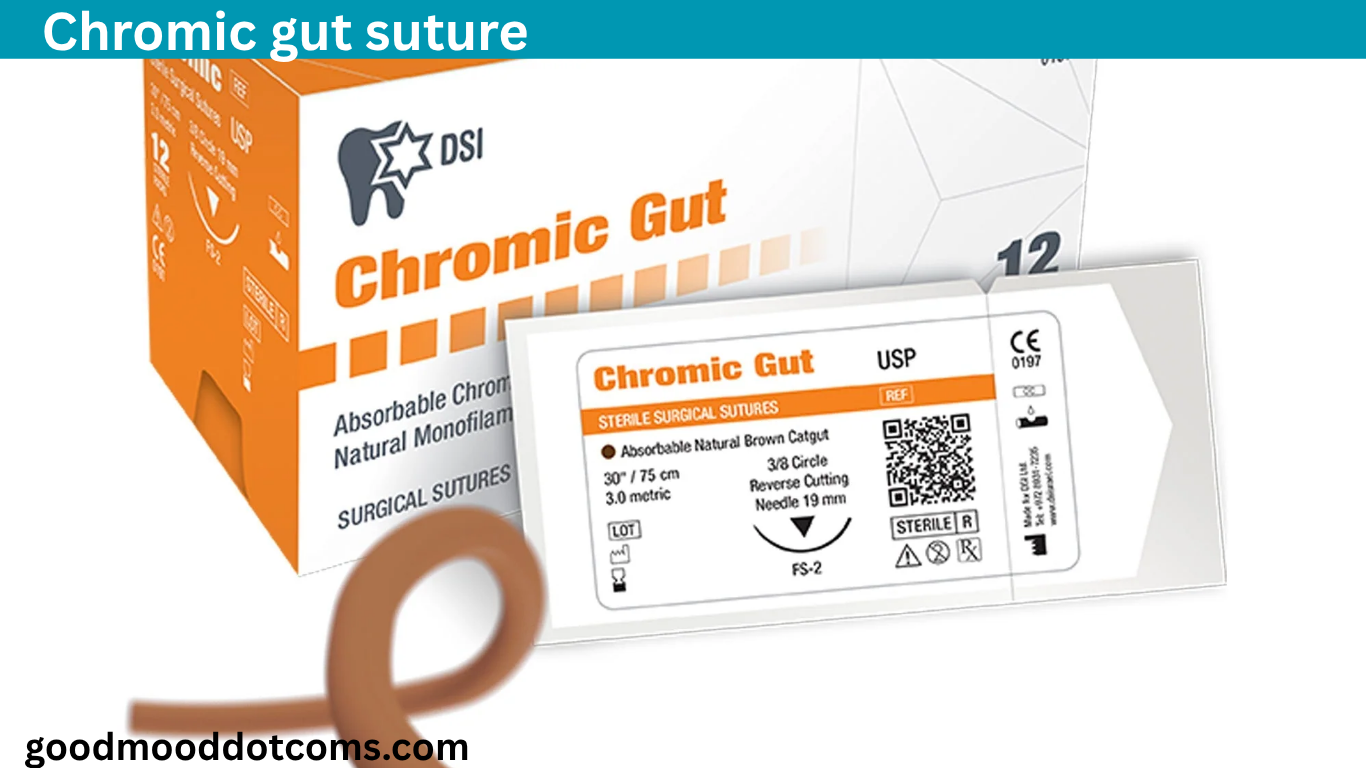
A chromic gut suture is a type of absorbable surgical suture used to hold body tissues together while a wound heals. It is made from purified collagen obtained from animal tissue and is specially processed so that it remains in the body longer than plain gut suture. Unlike nonabsorbable sutures, chromic gut suture is gradually broken down by the body, so it usually does not need to be removed after healing.
The term “chromic gut suture” may sound unusual to people outside healthcare, but it has a long history in surgical wound closure. Modern medical devices are available in different sizes and configurations, and their exact indications depend on the manufacturer and the procedure. In the United States, the FDA classifies chromic gut as an absorbable natural surgical suture. FDA records include multiple chromic gut products cleared for general soft-tissue approximation and ligation.
Understanding chromic gut suture is useful for students, healthcare professionals, patients who have received absorbable stitches, and anyone researching surgical wound closure. This guide explains what chromic gut is, how it works, how long it can remain in tissue, where it may be used, how it compares with other sutures, and what limitations should be considered.
What Is a Chromic Gut Suture?
Chromic gut suture is an absorbable natural surgical suture made primarily from purified collagen. Depending on the product, the collagen is derived from the serosal layer of cattle or the submucosal fibrous layer of sheep intestines. It is processed to make it more resistant to absorption than ordinary plain gut suture.
The word “gut” does not mean that the suture is made from the contents of the intestine. Instead, the material comes from collagen-rich connective tissue obtained from animal intestines and then processed for medical use.
“Chromic” refers to the processing used to increase the material’s resistance to absorption. This gives chromic gut a longer useful period of wound support compared with plain gut.
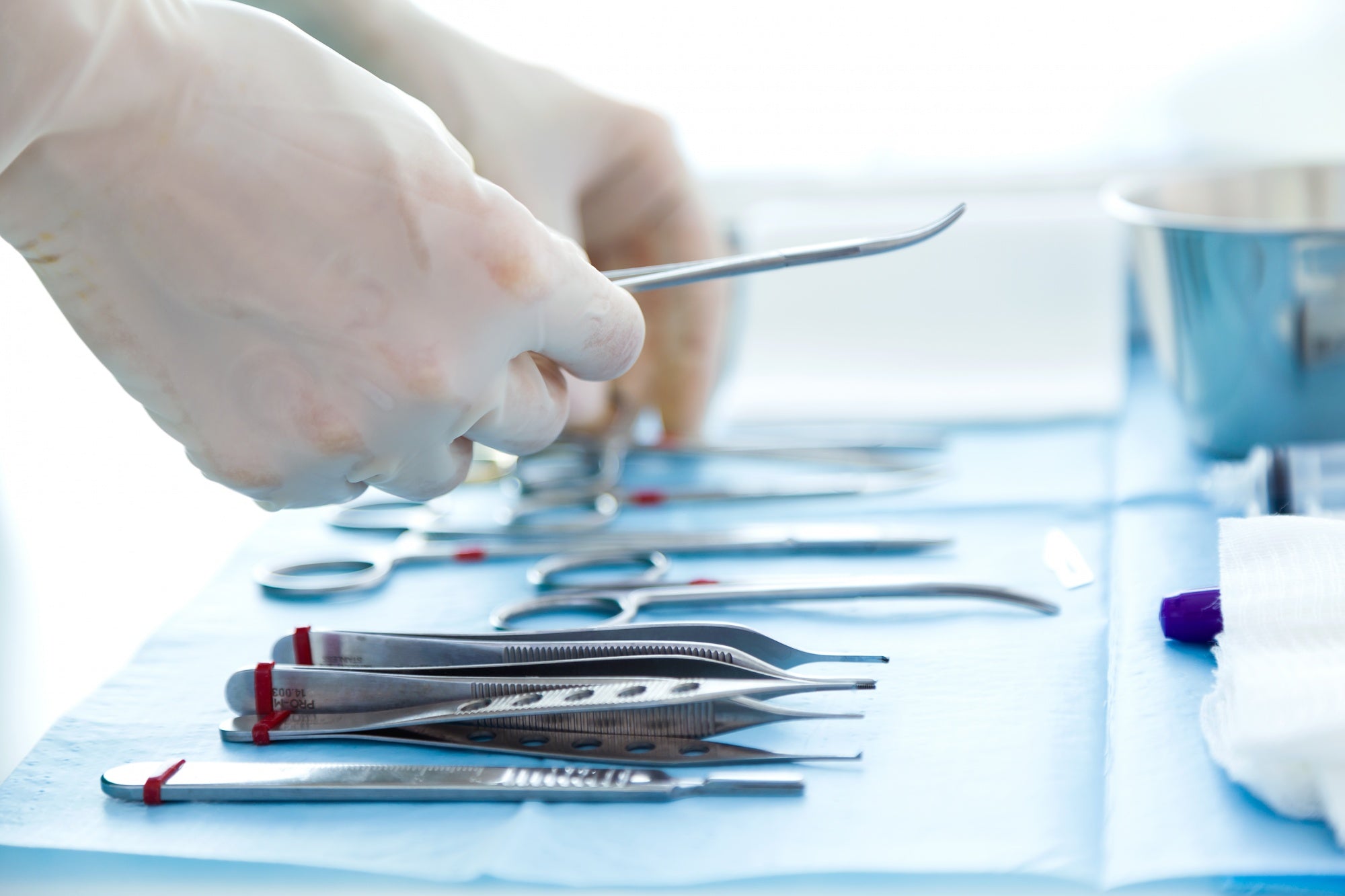
XS Supply
The result is a sterile, absorbable suture that can provide temporary tissue support without requiring a later procedure to remove the thread.
Why Is It Called Chromic Gut?
The name comes from the traditional use of chromium-containing processing to modify gut suture material.
The processing makes the collagen more resistant to breakdown by the body’s enzymes. In practical terms, chromic gut generally lasts longer than plain gut before it is absorbed.
This difference is important because wounds do not all heal at the same speed.
A superficial wound that needs only a short period of support may not require a longer-lasting suture. A wound in tissue that takes more time to heal may benefit from a material that remains longer.
Therefore, the choice of suture is not simply about choosing the strongest material. The surgeon considers how long the tissue needs support, the location of the wound, tissue characteristics, contamination risk, expected tension, and other clinical factors.
Is Chromic Gut Suture Absorbable?
Yes. Chromic gut suture is an absorbable suture.
The body gradually breaks down the collagen material through enzymatic processes. Because the material is absorbed, a patient generally does not need to return simply to have the suture removed.
This is one of the main advantages of absorbable sutures.
FDA records classify chromic gut under the category of absorbable natural sutures, and current medical-device listings continue to include chromic gut products.
However, “absorbable” does not mean that the thread disappears immediately. The rate of absorption varies according to the material, tissue environment, suture size, individual healing, and the specific product.
How Does Chromic Gut Suture Work?
The basic purpose of a surgical suture is mechanical.
When tissue has been cut or separated, the surgeon can use a suture to bring the tissue edges together. This allows the body’s natural healing process to take place in a more controlled position.
Chromic gut provides temporary mechanical support.
Over time, new tissue develops and gains strength. Meanwhile, the suture gradually loses strength and is eventually absorbed.
This creates a useful relationship between the suture and the healing wound.
At first, the suture provides support.
As healing progresses, the tissue becomes increasingly responsible for maintaining its own strength.
As the suture is no longer needed, the body breaks it down.
What Is Chromic Gut Made Of?
Chromic gut is primarily a collagen-based material.
Current product information from J&J MedTech describes surgical gut sutures as being composed of purified connective tissue, mostly collagen, obtained from either bovine or ovine intestinal tissue.
The material undergoes processing and sterilization before it is supplied for surgical use.
Different manufacturers may have different manufacturing processes, packaging systems, coatings, needle combinations, and product specifications.
For this reason, healthcare professionals should use the specific manufacturer’s instructions for use rather than assuming that every chromic gut product behaves exactly the same way.
Chromic Gut vs. Plain Gut
Plain gut and chromic gut are closely related materials, but they are not identical in clinical behavior.
Plain gut is designed to be absorbed relatively quickly.
Chromic gut is specially processed to provide greater resistance to absorption.
In simple terms:
- Plain gut generally disappears sooner.
- Chromic gut generally remains longer.
- Both are natural absorbable sutures.
- Both are primarily collagen-based.
- The appropriate choice depends on the wound and expected healing period.
This difference can be important when a surgeon needs temporary support for longer than plain gut can reasonably provide.
How Long Does Chromic Gut Suture Last?
There is no single absorption time that applies to every chromic gut suture.
The exact duration depends on the specific product, suture size, tissue environment, patient factors, and other conditions.
It is therefore better to avoid promising a specific number of days or weeks unless referring to the instructions for a particular product.
The important general principle is that chromic gut is designed to resist absorption longer than plain gut.
The manufacturer’s instructions should be consulted for exact performance characteristics.
This is especially important because patients sometimes notice a small piece of suture material after a procedure and assume that something has gone wrong. In some situations, absorbable suture material can remain visible or can work its way toward the surface during healing.
That does not automatically mean that the wound is infected or that the procedure failed.
However, unusual swelling, increasing pain, pus, fever, spreading redness, or wound separation should be evaluated by a healthcare professional.
Why Absorption Time Matters
Absorption time matters because a wound needs support while it heals. If a suture loses strength too quickly, the wound may not receive enough support, while a suture that stays too long may cause unnecessary tissue irritation. Surgeons therefore choose a suture based on the tissue, wound location, healing time, and amount of support needed. The goal is not to use the strongest suture, but to use the one that best matches the wound’s healing needs.
Where Is Chromic Gut Suture Used?
Chromic gut suture has historically been used for general soft-tissue approximation and ligation.
FDA-cleared chromic gut products have included indications for general soft-tissue approximation and/or ligation, including certain ophthalmic applications, while specifically excluding cardiovascular and neurological tissue applications for the cited products.
The exact use depends on the particular product and its labeling.
Possible clinical applications may include selected procedures involving soft tissue where an absorbable natural suture is appropriate.
Healthcare professionals should always follow the specific instructions for use rather than assuming that a suture approved for one application is appropriate for another.
Chromic Gut Suture in Soft Tissue
Soft tissue includes structures such as skin, connective tissue, mucosal tissue, and other non-bony tissues.
Chromic gut can be used for selected soft-tissue closure when temporary absorbable support is appropriate.
The surgeon evaluates several factors before choosing it.
These may include:
- Tissue type
- Wound location
- Tissue tension
- Expected healing time
- Degree of contamination
- Infection risk
- Need for later suture removal
- Desired duration of support
- Patient-specific considerations
This is why suture selection is a clinical decision rather than something patients should make based solely on the name of the material.
Chromic Gut Suture in Oral and Dental Procedures
Absorbable sutures can be useful in certain oral and dental procedures because removing stitches from the mouth can be inconvenient.
Chromic gut has historically been used for selected oral soft-tissue closures.
However, the choice depends on the procedure and the clinician’s preference.
Modern dentistry also uses several synthetic absorbable materials, so chromic gut is not automatically the best choice for every dental procedure.
The patient’s healing needs, the location of the incision, expected moisture exposure, and the desired handling properties all matter.
Chromic Gut Suture in Obstetric and Gynecologic Procedures
Absorbable sutures have long been used in procedures involving soft tissue in obstetrics and gynecology.
Chromic gut has historically been used in certain types of tissue repair because it can provide temporary support and does not normally require removal.
However, modern practice has many synthetic absorbable alternatives.
The exact suture used depends on the procedure, clinician preference, tissue characteristics, and product labeling.
Patients should not assume that every absorbable stitch used after childbirth or gynecologic surgery is chromic gut.
Chromic Gut Suture in Ophthalmic Procedures
Some FDA records specifically describe chromic gut sutures as being indicated for certain ophthalmic procedures.
However, eye surgery is highly specialized.
Suture selection in ophthalmology requires careful consideration of tissue characteristics, inflammation, precision, and the location of the repair.
A particular chromic gut product may have an ophthalmic indication while another product may have different labeling.
This is another reason the product-specific instructions matter.
What Are the Advantages of Chromic Gut Suture?
Chromic gut has several characteristics that can make it useful in selected situations.
Its most obvious advantage is that it is absorbable.
That means the patient generally does not need a separate appointment solely for suture removal.
Another advantage is that it is natural and collagen-based.
It can also provide temporary support for a longer period than plain gut.
Chromic gut is available in multiple sizes and needle configurations depending on the manufacturer and product line.
FDA records show that multiple manufacturers have produced chromic gut products that fall under the absorbable natural suture classification.
What Are the Disadvantages of Chromic Gut?
Chromic gut is not perfect.
Because it is a natural collagen material, the body can produce an inflammatory response around it.
Modern synthetic absorbable sutures are often selected when predictable absorption and lower tissue reactivity are important.
Chromic gut also has less predictable absorption than many modern synthetic materials.
Its strength gradually declines as the body breaks it down.
This is not necessarily a problem. It is part of how the material is designed to work.
The key issue is whether its behavior is appropriate for the particular wound.
Can Chromic Gut Cause Inflammation?
Any implanted suture can cause some degree of local tissue reaction.
Chromic gut is a natural protein-based material, so tissue reaction can occur as the body recognizes and gradually breaks down the collagen.
A small amount of local inflammation can be part of normal healing.
However, significant inflammation is different.
Increasing redness, warmth, swelling, worsening pain, pus, fever, or wound separation can indicate a complication and should be assessed by a healthcare professional.
A patient should not assume that every red or swollen wound is simply reacting normally to chromic gut.
Can Chromic Gut Cause an Infection?
A suture itself does not automatically cause an infection.
Surgical infections involve many factors, including the wound, bacteria, patient health, surgical environment, tissue damage, and postoperative care.
However, any foreign material placed in tissue can influence the local environment.
This is one reason sterile manufacturing, proper surgical technique, wound care, and appropriate patient selection are important.
Chromic gut products are supplied as sterile surgical devices when appropriately manufactured and packaged. FDA records identify chromic gut products as absorbable natural surgical sutures.
What Does Chromic Gut Look Like?
Chromic gut suture is commonly supplied in a brown or dark-colored appearance, although the appearance can vary by product.
The color can help healthcare professionals distinguish it from other suture materials.
The strand is flexible and is supplied with different needle options depending on the intended use.
Patients may sometimes see a small thread at the wound site after surgery.
The appearance alone cannot determine whether the wound is healing properly.
The surrounding tissue and symptoms are much more important.
Is Chromic Gut a Monofilament or Multifilament Suture?
The classification can be confusing because traditional gut sutures are often described in ways that do not fit neatly into the simple modern monofilament-versus-braided categories used for synthetic sutures.
Product construction and terminology can vary.
For clinical purposes, the more important characteristics are the material, absorbability, tissue response, tensile strength, handling properties, and manufacturer’s specifications.
Healthcare professionals should use the exact product information rather than relying on general descriptions.
Chromic Gut Suture Sizes
Like other surgical sutures, chromic gut is available in different sizes.
Suture size affects characteristics such as:
- Tensile strength
- Tissue penetration
- Handling
- Knot security
- Amount of material left in tissue
- Intended tissue application
The appropriate size depends on the tissue and procedure.
A thicker suture is not automatically better.
A very large suture can create unnecessary tissue reaction, while a suture that is too small may not provide adequate support.
The surgeon chooses the size based on the clinical situation.
Understanding USP Suture Sizes
Surgical suture sizes are commonly described using the United States Pharmacopeia system.
The system uses numbers such as 2-0, 3-0, 4-0, and 5-0.
Generally, more zeros indicate a finer suture.
For example, 5-0 is finer than 2-0.
This does not mean that one size is universally better.
The size must match the tissue and the required mechanical support.
FDA-cleared gut suture products are tested against applicable specifications involving characteristics such as diameter and tensile strength.
Chromic Gut vs. Synthetic Absorbable Sutures
Modern surgery has many synthetic absorbable materials.
Examples include polyglactin 910 and other synthetic polymers.
Synthetic absorbable sutures can offer predictable absorption profiles and consistent mechanical characteristics.
Chromic gut has the advantage of being a long-established natural material, but its biological behavior is different.
For example, J&J MedTech describes chromic gut as purified collagen-based material and contrasts it with synthetic absorbable products such as polyglactin 910.
The best material depends on the clinical situation.
Chromic Gut vs. Vicryl
Vicryl is a commonly recognized brand name for polyglactin 910, a synthetic absorbable suture.
Chromic gut is a natural collagen-based absorbable suture.
The two materials differ in composition, tissue response, handling, and absorption characteristics.
J&J MedTech describes VICRYL RAPIDE as a synthetic absorbable suture designed for superficial soft-tissue approximation where only short-term wound support is required.
This illustrates an important point: modern suture selection often involves choosing among materials with very different performance profiles.
Chromic Gut vs. Nylon
Nylon is generally considered a nonabsorbable synthetic suture.
Because nylon does not normally dissolve in the body in the same manner as chromic gut, external nylon sutures often need to be removed when appropriate.
Chromic gut, in contrast, is designed to be absorbed.
Therefore, the choice between these materials may involve whether long-term mechanical support is required and whether later removal is practical.
Chromic Gut vs. Prolene
Prolene is polypropylene, a synthetic nonabsorbable suture material.
It is known for long-term persistence in tissue.
Chromic gut has the opposite general concept: temporary support followed by absorption.
Neither is automatically better.
A surgeon chooses according to tissue, healing requirements, location, and desired duration of support.
Chromic Gut vs. PDS
PDS is a commonly used name for polydioxanone suture.
It is a synthetic absorbable material designed to retain support for a relatively long period compared with some other absorbable sutures.
Chromic gut and PDS therefore differ in both material and absorption behavior.
When prolonged absorbable support is needed, a surgeon may consider a synthetic option such as polydioxanone depending on the procedure.
Why Modern Synthetic Sutures Became Important
Suture technology has changed considerably.
Natural materials such as gut were important for many years because they offered absorbability without requiring removal.
Modern synthetic materials were developed to provide more predictable mechanical and absorption characteristics.
This does not make chromic gut obsolete.
Instead, it means surgeons have more choices.
The availability of multiple materials allows clinicians to match the suture more closely to the biological requirements of each procedure.
Does Chromic Gut Need to Be Removed?
Usually, the main reason for choosing chromic gut is that it is absorbable.
Therefore, it generally does not require routine removal like many external nonabsorbable sutures.
However, absorbable does not mean that every visible piece will disappear immediately.
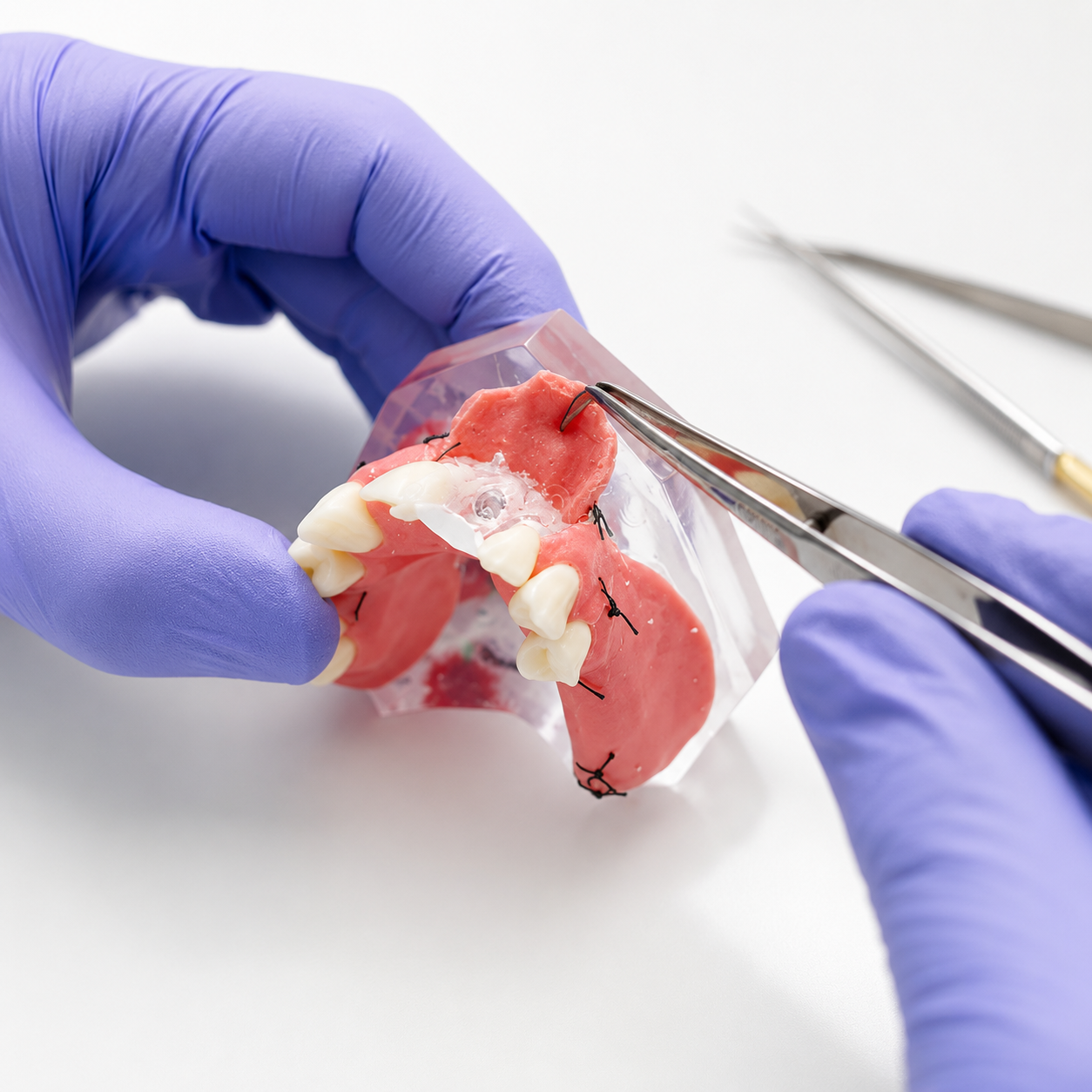
Dental Bone Graft,Structure, Surgical Burs for oral surgery
Occasionally, a suture end may remain visible or may be expelled as the tissue heals.
If a patient notices persistent suture material, they should ask the healthcare professional who performed the procedure rather than cutting or pulling it out themselves.
What Happens if a Chromic Gut Suture Comes Out?
A small amount of absorbable suture material coming loose does not always mean there is a serious problem.
The importance depends on where the suture is located, how long ago the procedure occurred, whether the wound remains closed, and whether there are signs of infection or other complications.
Do not pull on a suture that appears to be attached to deeper tissue.
Contact the treating clinician if there is uncertainty.
Can You Pull Out Chromic Gut Yourself?
It is generally not a good idea to pull out a surgical suture yourself.
Even if the material is intended to absorb, the visible portion may still be connected to tissue.
Pulling it can cause bleeding, tissue injury, or wound separation.
If an absorbable suture is irritating the skin after the wound has healed, a healthcare professional can determine whether the remaining material should be trimmed or removed.
Chromic Gut Suture and Wound Healing
A suture does not heal a wound by itself.
It creates a physical environment that helps tissue remain in the desired position while the body’s healing processes occur.
Healing involves inflammation, formation of new tissue, collagen production, remodeling, and gradual strengthening.
The suture provides temporary support during this process.
This is why the correct suture material is only one part of successful wound closure.
Patient health, nutrition, blood flow, infection control, smoking, diabetes, medications, and wound location can all influence healing.
Factors That Can Affect Wound Healing
Several factors can make wounds heal more slowly.
These may include:
- Diabetes
- Poor circulation
- Smoking
- Infection
- Poor nutrition
- Certain medications
- Advanced age
- Immune-system problems
- Significant tissue damage
- Excessive tension on the wound
These factors are important regardless of whether the surgeon uses chromic gut or another suture.
A good suture cannot completely overcome poor biological conditions.
Does Chromic Gut Leave a Scar?
The type of suture can influence the appearance of a scar, but it is only one factor.
Scar formation depends heavily on wound location, depth, tension, genetics, infection, inflammation, sun exposure, and individual healing.
A wound closed with chromic gut can still produce a scar.
Likewise, changing the suture material cannot guarantee a scar-free result.
Patients concerned about scarring should discuss expectations and postoperative wound care with their healthcare professional.
Potential Complications Associated With Sutures
Possible complications of surgical sutures can include:
- Local inflammation
- Infection
- Bleeding
- Tissue reaction
- Wound separation
- Suture breakage
- Delayed healing
- Suture irritation
- Foreign-body reaction
- Scarring
The actual risk depends on the procedure, patient, suture material, surgical technique, and postoperative care.
Patients should follow the wound-care instructions provided by their healthcare team.
When Should You Contact a Healthcare Professional?
After a procedure involving chromic gut suture, seek medical advice if you develop concerning symptoms such as:
- Increasing rather than improving pain
- Significant swelling
- Pus or unusual drainage
- Spreading redness
- Fever
- Foul odor
- Heavy bleeding
- Wound edges separating
- New or worsening symptoms
These symptoms do not prove that the chromic gut is responsible.
They simply indicate that the wound may need professional evaluation.
Is Chromic Gut Safe?
Chromic gut is an established medical-device material, and FDA records show chromic gut products classified as absorbable natural sutures.
However, “safe” should not be interpreted as “risk-free.”
All surgical materials have potential advantages and disadvantages.
Some patients may have stronger inflammatory reactions to natural collagen-based materials than others.
The specific product’s instructions for use provide the most relevant safety information.
Why Product-Specific Information Matters
One of the easiest mistakes when researching surgical sutures is assuming that every product with the same general name has identical characteristics.
Manufacturers may differ in:
- Processing
- Sterilization
- Needle design
- Coating
- Packaging
- Suture size
- Labeling
- Indications
- Performance specifications
FDA records show multiple manufacturers and product submissions for chromic gut, demonstrating that the category includes numerous products.
For this reason, healthcare professionals should consult the exact product’s instructions.
What Does FDA Clearance Mean for Chromic Gut?
FDA records show chromic gut products submitted through the 510(k) pathway and classified as absorbable natural surgical sutures.
For example, the FDA lists a chromic catgut product under regulation number 878.4830 and product code GAL.
Some FDA records describe intended use for general soft-tissue approximation and ligation, including certain ophthalmic procedures, with exclusions for cardiovascular and neurological tissue.
This information helps establish the regulatory category and intended uses, but it does not mean every chromic gut product is approved for every surgical application.
What Healthcare Students Should Remember
For students learning about surgical sutures, the most useful approach is to remember the major characteristics rather than memorizing isolated facts.
Chromic gut is:
- Natural
- Collagen-based
- Absorbable
- Processed for increased resistance to absorption
- Used for selected soft-tissue approximation and ligation
- Available in different sizes and configurations
- Different from synthetic absorbable sutures
The key concept is temporary mechanical support followed by biological absorption.
What Patients Should Remember
If you have been told that your surgeon used chromic gut, you generally do not need to worry simply because the material is called “gut.”
The name refers to the source of purified collagen material used to manufacture the suture.
It does not mean that untreated intestinal tissue was placed into your wound.
Modern surgical gut sutures are manufactured, processed, sterilized, packaged, and regulated as medical devices.
The FDA has records for chromic gut products classified as absorbable natural sutures.
The Biggest Lesson About Chromic Gut Suture
The most important point is that chromic gut suture is not simply an old-fashioned stitch. It is a specific absorbable natural surgical material designed to provide temporary tissue support and then gradually break down.
Its major distinguishing feature is its collagen-based composition and processing that gives it greater resistance to absorption than plain gut.
However, it is not automatically the best suture for every wound.
Modern surgeons can choose from many absorbable and nonabsorbable materials, including synthetic options with different strength, handling, tissue-response, and absorption characteristics.
The right suture is the one whose properties match the clinical requirements of the tissue and procedure.
How to Think About Chromic Gut in Modern Surgery
It is useful to view chromic gut as one option within a much larger family of surgical sutures.
The question is not simply, “Is chromic gut good?”
A better question is, “Is chromic gut appropriate for this particular tissue, wound, and expected healing period?”
That question leads to a more accurate understanding of surgical wound closure.
A surgeon may select chromic gut when temporary absorbable support is desirable and the characteristics of natural gut are suitable.
Another surgeon may choose a synthetic absorbable material because its absorption profile or tissue response better matches the procedure.
Both decisions can be reasonable.
Final Thoughts
Chromic gut suture is a natural, absorbable surgical suture made primarily from purified collagen obtained from bovine or ovine intestinal tissue. It is specially processed to resist absorption longer than plain gut and has been used for selected soft-tissue approximation and ligation. FDA records continue to classify chromic gut products as absorbable natural sutures, with specific products carrying their own indications and limitations. Its main benefit is temporary wound support without routine suture removal, while its natural collagen composition can produce tissue reactions that should be considered when choosing a closure material. Modern synthetic absorbable sutures provide additional options, so chromic gut is best understood as one tool among many rather than a universally superior suture. For patients, the most important thing is to follow postoperative instructions and contact a healthcare professional if the wound becomes increasingly painful, swollen, red, infected-looking, or separated.
Frequently Asked Questions About Chromic Gut Suture
Is chromic gut suture dissolvable?
Yes. Chromic gut is an absorbable suture, meaning the body gradually breaks down the collagen material rather than requiring routine removal.
Is chromic gut made from animals?
Yes. Modern surgical gut sutures are made from purified collagen obtained from animal intestinal tissue, commonly bovine or ovine sources.
Is chromic gut better than synthetic absorbable sutures?
Not necessarily. Chromic gut and synthetic absorbable sutures have different properties. The appropriate choice depends on the tissue, procedure, healing requirements, and surgeon’s clinical judgment.
Can chromic gut suture cause a reaction?
Yes. Like other implanted suture materials, chromic gut can produce local tissue inflammation or other reactions. Increasing redness, swelling, pain, drainage, or fever should be evaluated by a healthcare professional.
Does chromic gut suture need to be removed?
Because it is absorbable, chromic gut generally does not require routine removal. However, a small portion can sometimes remain visible during healing, and patients should not pull or cut it themselves without professional advice.
Social Sharing
Your Content Goes Here
Latest Posts